
Edward Davenport – “Fast Eddie” to the tabloids, “Lord Davenport” to himself, “convicted fraudster” to the Serious Fraud Office – first met Bonnie Blue at a party. She needed a venue to sleep with 1,000 men in. (Hotels had, perhaps understandably, turned her down.) Luckily, Davenport was in possession of 32 Portland Place, a £15m mansion in Marylebone. He saw no reason not to provide the space. “Because it’s a house, and because I’m single, and because it doesn’t really matter to me, having any sort of Bonnie Blue stigma doesn’t really affect me,” he explained. The result, filmed and later watched by millions on OnlyFans, made Blue, briefly, the most discussed woman in Britain – celebrated in some quarters as a liberated agent of her own sexuality, condemned in others as a symptom of civilisational collapse, dissected everywhere with a breathless combination of prurience and moral alarm. Davenport enjoys this kind of attention. “It’s exceptional PR… and fun for me, and a talking point when you go out.” Blue appears regularly on his Instagram, with posts suggesting that the pair have an intimate relationship, and that he may even be the father to her unborn child. (She later admitted the pregnancy was fake.) Davenport described his role in all this in simple terms: “We work mutually well together,” he said. “She’s the owner of her content, but I definitely help with the location side, the idea side, the structure of it side, and how it’s going to work and operate.”
Davenport’s journey to becoming Britain’s answer to Hugh Hefner started young. The son of a west London restaurateur (the title, he claims, came with a property in Shropshire), he told me his upbringing meant he was used to hosting. Aged just 16, he organised “Gatecrasher balls”, gatherings in country mansions for public-school pupils. By 24 he was already in trouble with the taxman – jailed for nine months for failing to charge VAT on tickets, though he served just 16 days. Upon release, Tatler asked how he had found prison. “Boring,” he said. “There aren’t many parties there.” No 32 is the second home Davenport has owned in the area. He originally hosted events at No 33, just across the road – the former embassy of Sierra Leone, which he acquired during the country’s civil war – but was forced to sell it in 2015 to pay the Serious Fraud Office (SFO) a £14m Compensation and Confiscation Order. In 2011 he was jailed for seven years, eight months for fraud, after conning clients out of millions. Davenport was released after three years for health reasons. He denies any wrongdoing. “I went from being the richest person in the neighbourhood when I was in prison,” he told me, “to the poorest person in the neighbourhood in Mayfair.”
Over time, Davenport’s crowd has shifted, and he has adjusted accordingly. The Russians have largely gone – sanctioned or forced to leave, the grand charity balls at Grosvenor House and the Dorchester gone with them. “The demographic changes slightly, but fortunately I seem to identify with most of them one way or another,” he said. “[When I began] I was throwing them mainly for public school kids, Sloane rangers they were called in those days. That demographic changed quite considerably. There were a whole lot of new people coming in from different places – China, Russia, all these Arabic countries.” At his parties today are what he calls “affluent young Londoners” – some aristocrats, some musicians, some singers, students from China at London universities – who have heard about mansion gatherings and find their way through a friend of a friend. People who haven’t been out in years suddenly reappear, freshly divorced. His great-niece came recently with a hundred friends from UCLA, all of them wanting to hear about Bonnie Blue. “It’s the first thing they ask.” The old crowd has thinned, he conceded. “It’s not purely aristocrats like it used to be. Over the decades they’ve diluted a bit.” The changing nature of the clientele reflects, in its own way, the shifting landscape of power and wealth in the UK over the past few decades, from old aristocracy to new money, and from homegrown to global elites. One thing remains constant: his approach. “Get loads of girls there.”
There is a line that runs, unbroken, from the Hellfire Club to Portland Place. It passes through the brothels of Victorian Haymarket, through the Soho of the 1950s where Christine Keeler drifted between jazz clubs and ministerial bedrooms, through the Essex mansion parties of the 1980s where the newly wealthy discovered that transgression was something you could buy if you had enough money. The line is not really about sex. It is about a very English negotiation between respectability and its opposite – the need, among the wealthy and powerful, to periodically demonstrate that they are above the rules. On a black winter’s night, I went to see who’s buying.

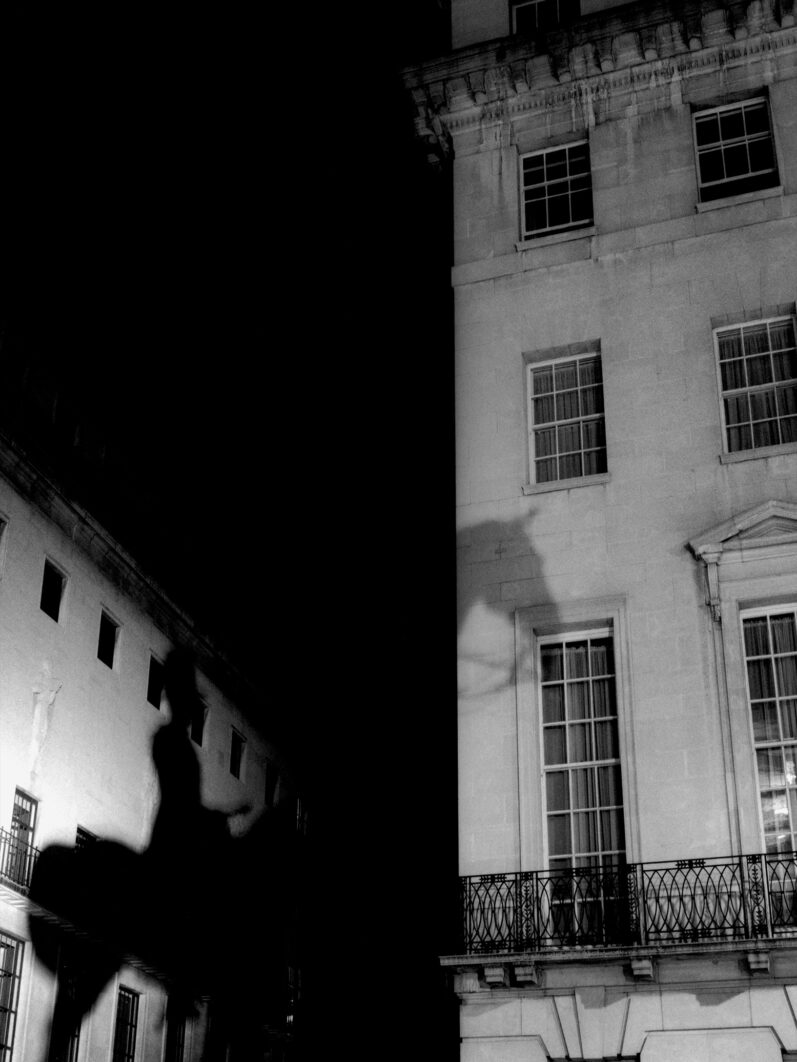
In the daytime it’s easy to miss No 32. Sitting on a busy corner in Marylebone, central London, the Georgian mansion blends in among embassies and townhouses. But on weekends, after dark, it comes alive. Guests move in and out between its tall Palladian pillars. Models and musicians swarm its stone staircases for art salons and fashion shows run by the Anglo-Russian artist Philip Firsov, whose work covers its walls. Like Blue, Firsov struck up a friendship with Davenport after meeting him at a party. He understands the value of the environment Davenport creates. “He has a certain public image, but when you get to know him he’s a really nice guy,” he told me. Firsov hosts art salons and fashion shows at the house, and his paintings hang in the same room where Blue set her record. He described the video as a “stunt”. “My art was in the porn film, which I have seen, unfortunately – there were a million views. So what do you do about it, do you complain or do you go with it?” He added: “I’m now the most known unknown artist in the world.”
I arrived at the tail end of one of Firsov’s parties. Entry was £100 for men and free for women. A group of men hovered outside, arguing over whether it was “worth it”. Davenport greeted me on the way in. He was wearing a suit, and his thin pale skin looked artificially smooth. Inside, the walls were covered with lewd art. In the cloakroom hung an enormous tapestry depicting men in military uniform relaxing with naked women. A bouncer stood by a staircase; the way blocked by a red rope and rail. I asked what was up there. “Bedrooms, for VIPs only,” he replied.
Women in sequinned dresses drifted through the house’s grand rooms, the low lighting failing to make them glitter. Men wearing crisp shirts and heavy watches laughed a little too loudly. I headed to the bathroom. An American man banged on the door and asked if I was doing cocaine inside. (I wasn’t.) I opened the door and he introduced himself. He told me he had multiple lawyers on retainer, that it came with the territory of being an “ultra-high-net-worth man”. “Once a girl starts talking crazy, I send a message to my lawyer, make a group chat with her and my lawyer, and say ‘you guys can talk’,” he said. The accusations the girls made were, of course, all lies.
I asked the source of his wealth: “business”, he answered. “Import and export.” He showed me a video of him pouring a pile of cash on to a bed and rolling in it. He wasn’t tall, but he was wide and well-built, wearing a three-piece suit, hat and orange-lensed glasses. I was wearing a cotton shirt and had to keep undoing buttons due to the heat. He wasn’t even sweating. He passed me a cigarette. Guests smoked openly inside. He asked if I was married; I told him I had a girlfriend. He offered to be the godfather of my future children. “The gifts will be good,” I replied. He asked if I would like to see a photo of his three children, and pulled out his phone before I could answer, scrolling intently. Finally, he showed me them. Three sports cars stared back at me. I went to buy a drink and lost him in the crowd. When I looked back, he was gone.
“My parties have always been popular,” Davenport told me. “It does help to keep up with all the latest things, rather than get stuck in the past.” The men I saw that night were part of that same pattern. Bodies huddled together, heads dipping and lifting, swan-like, from the tips of keys. On the dancefloor I met a woman who told me, laughing, that she wouldn’t leave her drink unattended. I asked why she was there: “It stays open late and it’s free,” she shrugged. The walls pulsated. I couldn’t make out the words to the reggaeton music. As time passed the club became noticeably more and more male. Men clustered against the walls, checking their phones, scanning faces, circling the rooms. Whatever sex was happening was occurring elsewhere, behind closed doors, leaving them to mill around restlessly. The house seemed to hold their hopes in its high ceilings, absorbing them into the plasterwork, letting them hang there like damp.
I decided it was time to leave. I spotted Davenport in the cloakroom, waving goodbye to a group of young partygoers. A woman was whispering in his ear. Outside, a group of young men pulled up in a taxi. One of them called out to me, asking what it was like inside. He wanted to know if there were many girls in there, or even if Bonnie was in attendance. I told him there were women, but the ratio was closer to Blue’s record attempt than he’d like. It looked for a moment like he might head inside. I added that it cost £100 to get in, and his face fell. For a moment he looked back at the house, weighing the possibilities against the price. He told his friend to rebook the Uber. “It’s not worth it,” they decided.
The street had fallen quiet again, with only the occasional car passing through Marylebone. And for all its suggestion of excess, what No 32 delivers is paler than the real thing. The necessarily clandestine world of Cliveden and Profumo depended on discretion. Davenport’s parties circulate openly, repackaged for platforms like OnlyFans and promoted in the same way as any other form of entertainment. If there are equivalents now to the scandals that once unsettled the establishment, they are happening elsewhere, out of view. At No 32, the old markers of British wealth have not disappeared so much as been put up for sale, like Davenport’s title. What he sells is the fantasy of proximity – to status, to a certain kind of permissiveness. And in Britain there is always someone willing to pay.
[Further reading: Do not celebrate the social media addiction ruling]
Content from our partners



Related


Join the debate
Subscribe here to comment